Best SendGrid alternatives in 2026
The best SendGrid alternative for most app teams is Unitpost: a permanent free plan of 5,000 emails a month, transactional and marketing email in one product, and a one-key import of contacts, suppressions and templates. Brevo sends the most for free, Postmark has the strongest deliverability record, and Mailgun and Amazon SES are built for very high volume.
Updated November 2, 2026. We make Unitpost, and it is on this list. Every score has a reason and the weights are published below, so you can re-rank it for your own needs. How we scored
| # | Product | Best for | Score |
|---|---|---|---|
| 1 | Unitpost | app teams sending both kinds of email | 4.3 |
| 2 | Brevo | marketers who want a full suite | 3.7 |
| 3 | Resend | developer-first transactional email | 3.6 |
| 4 | Mailgun | high-volume senders and validation | 3.2 |
| 5 | Postmark | mail that must reach the inbox | 3.1 |
| 6 | MailerSend | a cheap first paid plan | 2.7 |
| 7 | Amazon SES | lowest cost at very high volume | 2.5 |
Why teams look for a SendGrid alternative
- The free plan was retired in 2025: new accounts get a 60-day trial at 100 emails a day.
- Paid email plans start at $19.95 a month (Essentials).
- Marketing Campaigns is a separate product with its own plans.
When SendGrid is still the better choice
- You need sub-accounts to isolate sending for your own customers
- You need an enterprise contract, procurement paperwork, or a named support contact
- You depend on one of their many first-party integrations
What moves when you leave SendGrid
With Unitpost's Migration Assistant and one SendGrid key:
- Contacts: imports. The importer runs SendGrid's contact export (once for the account, once per list) and imports every Marketing contact with name and custom fields under their field names. Addresses you only emailed through Mail Send are not Marketing contacts unless you added them.
- Unsubscribes and consent: partly imports. Global unsubscribes import as unsubscribe suppressions, and those contacts land unsubscribed, which stops marketing here. Unsubscribe-group opt-outs are not read; step 2 copies them.
- Suppressions (bounces and complaints): imports. Bounces and spam reports import with their reason. Blocks import too, as suppressions that stop every send, although SendGrid itself stops suppressing a blocked address. Invalid emails are not read.
- Lists and segments: partly imports. Marketing lists become static segments with their members. SendGrid segments are not read, even though the preview shows a notice about them; rebuild them as dynamic segments.
- Topics: partly imports. Each unsubscribe group becomes a topic that contacts are enrolled in by default, as groups work. Nobody's group opt-out comes with it.
- Templates: partly imports. Dynamic templates import the active version's subject, HTML and text as drafts in code mode. Plain
{{name}}placeholders work; Handlebars helpers such as{{#if}}and{{#each}}do not, and legacy templates are not read. - Sending domains: partly imports. Authenticated domains are recreated as verifying with a new DKIM key. Link branding is not read.
- Webhooks: partly imports. Only the webhook behind SendGrid's single-webhook settings endpoint is read, so accounts with several Event Webhooks lose the rest. It is recreated switched off with a new signing secret.
- API keys: rebuild. Keys cannot be read. Create Unitpost keys with the scopes each service needs.
- Single Sends: rebuild. Not read. Recreate scheduled ones as campaigns on a segment.
- Subusers: rebuild. The importer reads only the account its key belongs to. Unitpost has no subusers, so give each subuser its own workspace and run the importer with a key from that subuser.
The picks
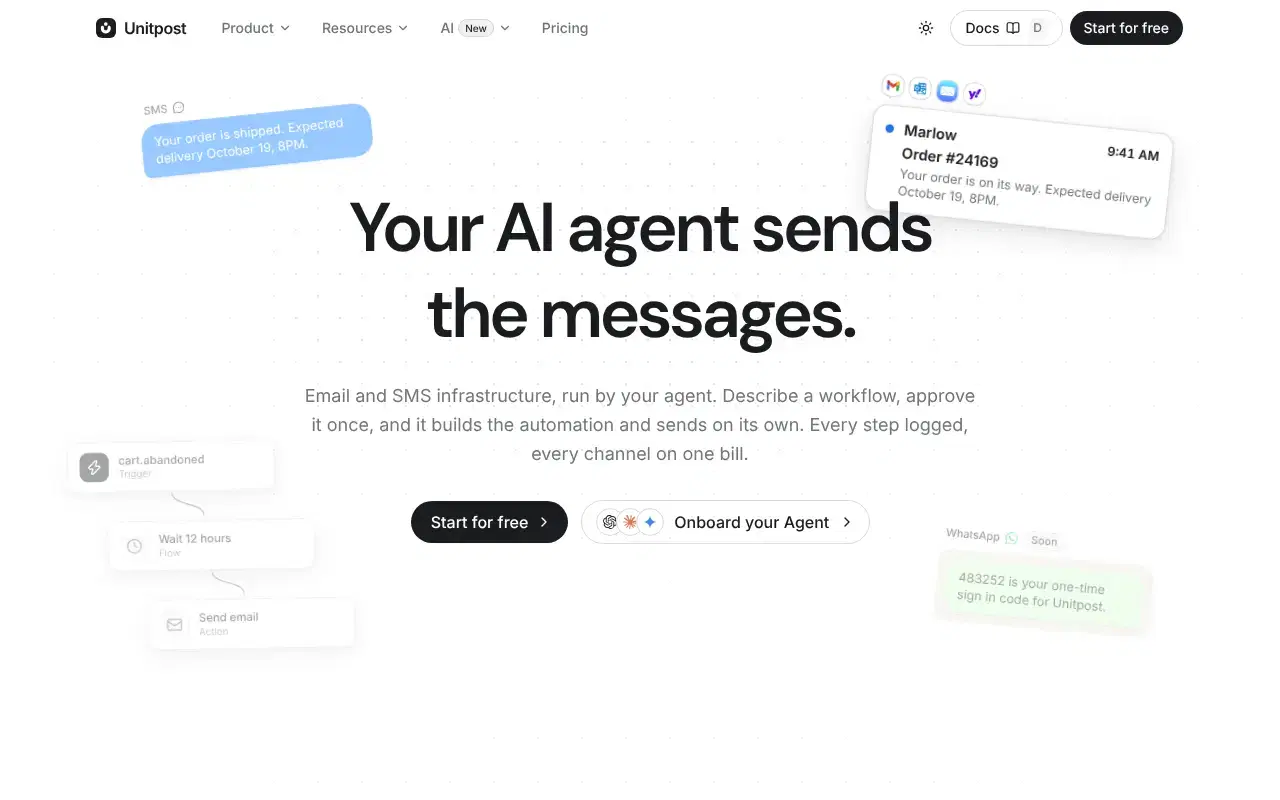
#1 · 4.3 / 5
Unitpost
Best for app teams sending both kinds of emailTransactional and marketing email on one API, one contact list and one bill, with a permanent free plan and an importer for six providers.
Pros
- Permanent free plan, no card
- Imports contacts, suppressions (bounces and complaints) from SendGrid with one key
- REST API, SMTP relay, MCP server and nine SDKs on every plan
- Unlimited contacts on paid plans, priced by sends
Cons
- A newer sender, without a long public track record
- No sub-accounts, and dedicated IPs are not launched yet
- SMS is on paid plans only
- Free plan
- 5,000 emails a month, 200 a day, no card
- Paid from
- $10 a month for 20,000 emails
- Priced by
- Emails sent
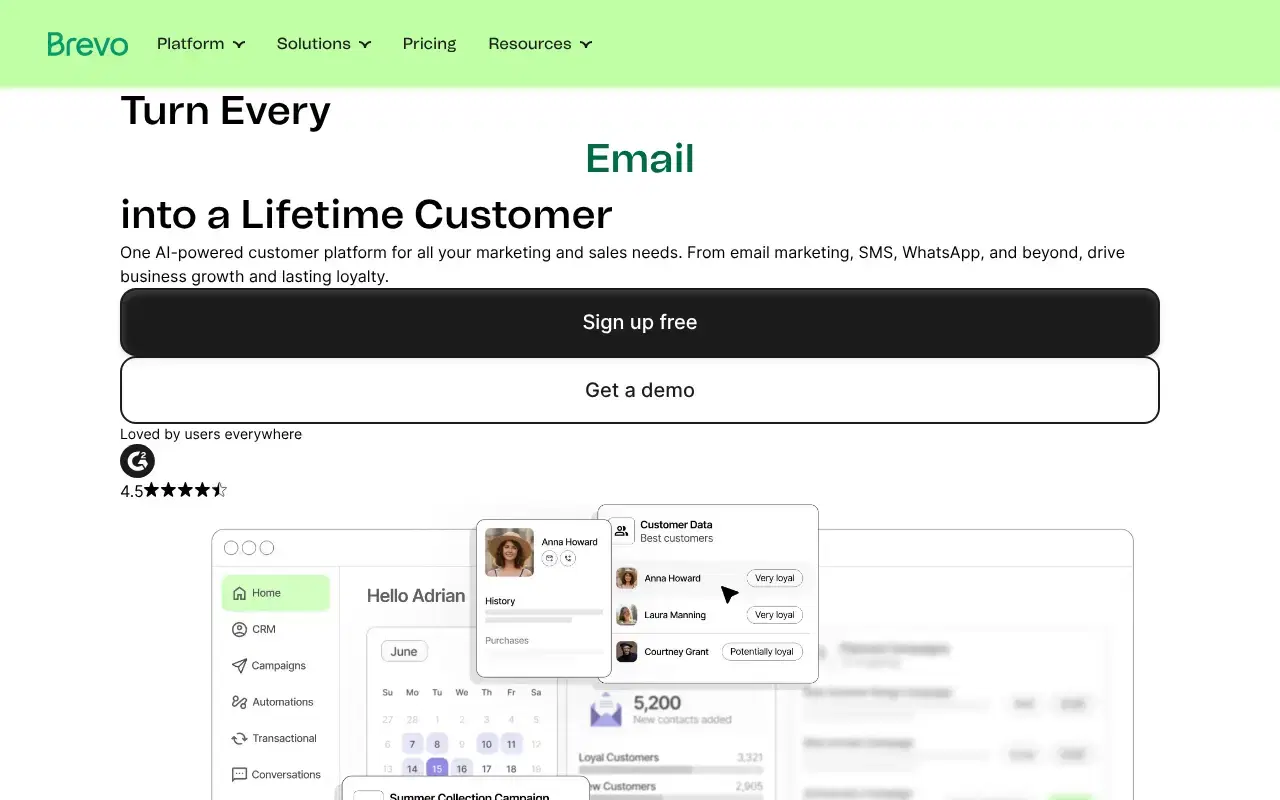
#2 · 3.7 / 5
Brevo
Best for marketers who want a full suiteA marketing suite with email, SMS, WhatsApp, a CRM and automation, plus a transactional API and SMTP relay. Its free plan sends the most email here.
Pros
- The largest free volume: 300 emails a day
- CRM, landing pages and automation built in
- Paid plans sized by email volume, from $9 a month
Cons
- SMS and WhatsApp credits are bought separately
- A large step in price from Standard to Professional
- Free plan
- 300 emails a day
- Paid from
- $9 a month for 5,000 emails
- Priced by
- Emails sent

#3 · 3.6 / 5
Resend
Best for developer-first transactional emailA clean, modern email API from the team behind React Email, with inbound email and an official MCP server on every plan. Marketing contacts are billed on a separate plan.
Pros
- A modern API with clear errors and many SDKs
- Inbound email on every plan, free included
- React Email for building templates in code
Cons
- Marketing is a second plan, priced by contacts ($40 a month for 5,000)
- Free sending is capped at 100 emails a day
- Free plan
- 3,000 emails a month, 100 a day
- Paid from
- $20 a month for 50,000 emails
- Priced by
- Sends and contacts
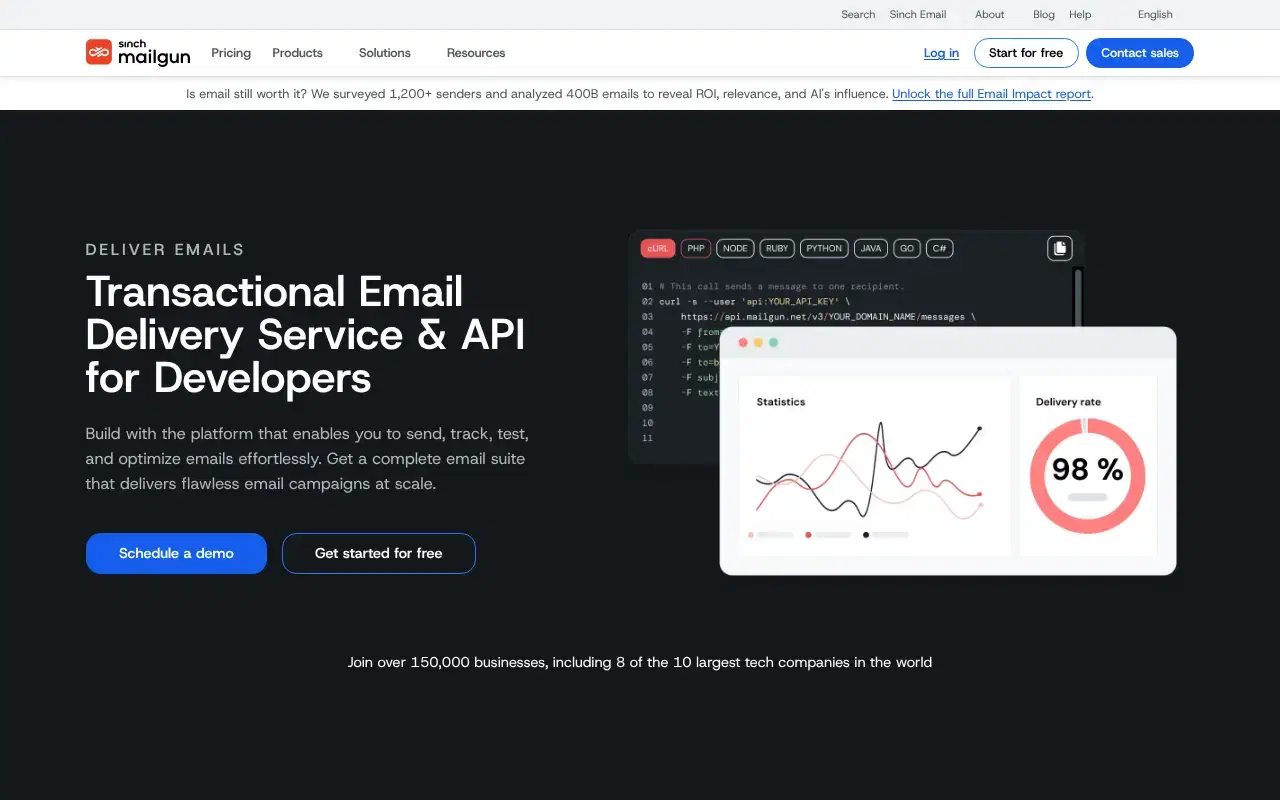
#4 · 3.2 / 5
Mailgun
Best for high-volume senders and validationA long-running email API with address validation and inbox placement testing. Strong at volume, with marketing campaigns left to other tools.
Pros
- Email validation and inbox placement testing
- EU region for data residency
- Proven at very high volume
Cons
- The free plan keeps logs for one day, on one domain
- Marketing campaigns need another tool
- Free plan
- 100 emails a day on one domain
- Paid from
- $15 a month for 10,000 emails
- Priced by
- Emails sent
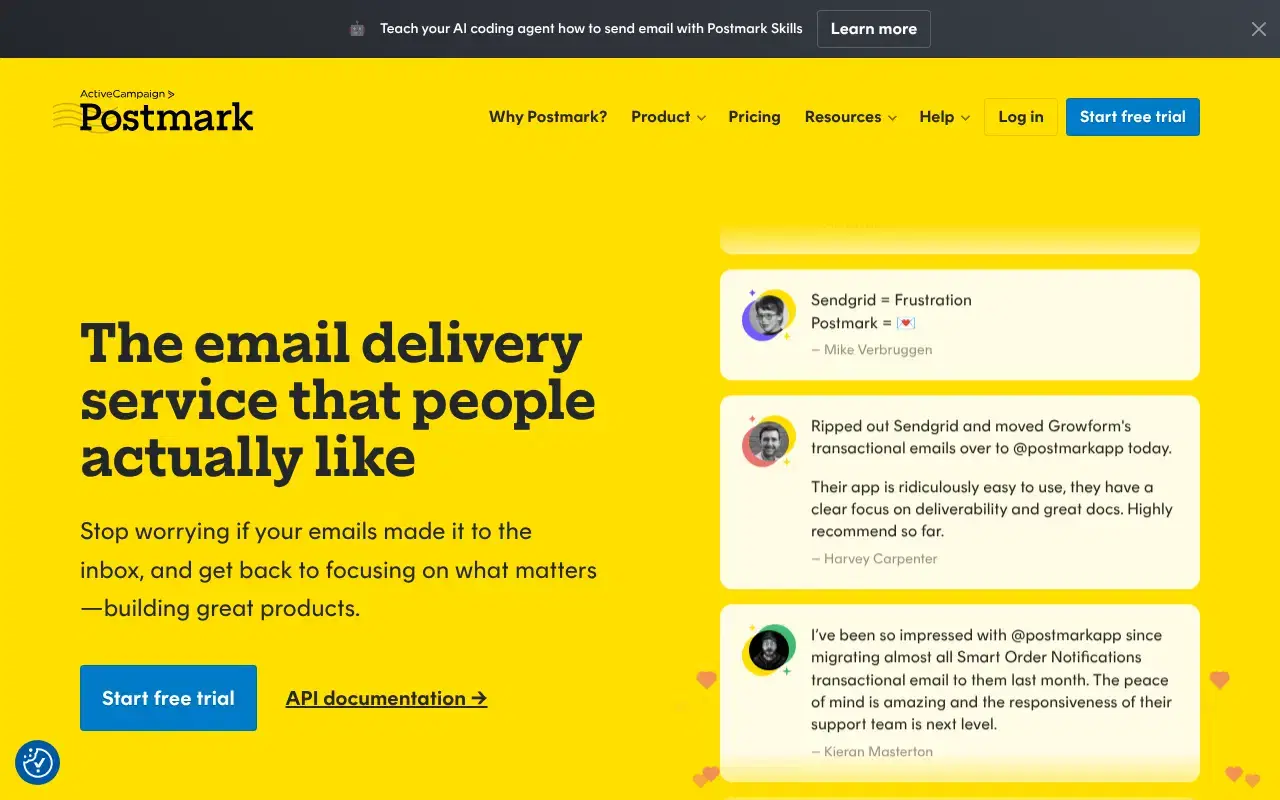
#5 · 3.1 / 5
Postmark
Best for mail that must reach the inboxTransactional email known for fast, reliable inbox placement, with bulk mail kept on separate broadcast streams. It costs more, and the free plan is for testing.
Pros
- The best-regarded deliverability record here
- Transactional and bulk mail kept on separate streams
- 45 days of message content and good debugging tools
Cons
- The free plan is 100 emails a month
- No audience or campaign tools, and no inbound on Basic
- Free plan
- 100 emails a month
- Paid from
- $15 a month for 10,000 emails
- Priced by
- Emails sent
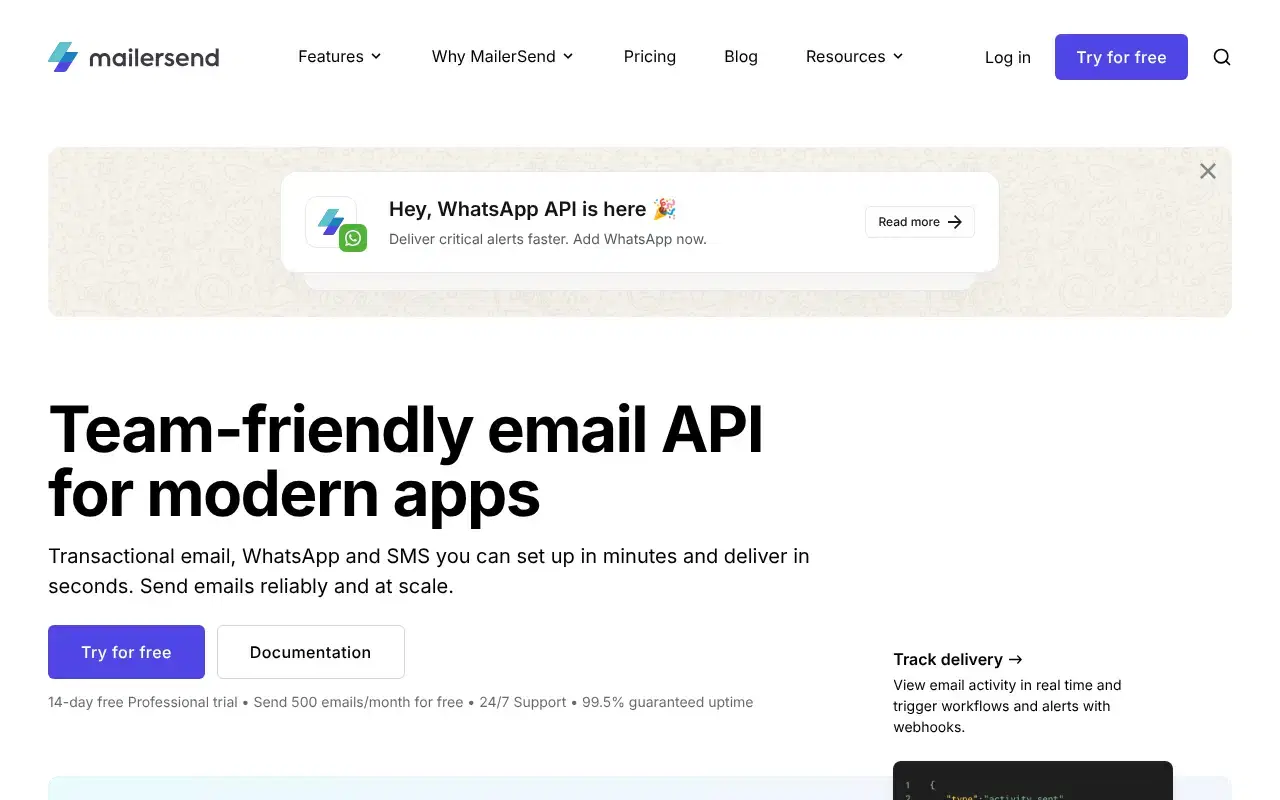
#6 · 2.7 / 5
MailerSend
Best for a cheap first paid planA transactional email API with an official hosted MCP server and a $7 first paid plan. The free plan is small.
Pros
- Hobby is $7 a month for 5,000 emails
- API and SMTP on the free plan
- An official hosted MCP server
Cons
- 500 emails a month on free
- No audience or campaign tools
- Free plan
- 500 emails a month, card required
- Paid from
- $7 a month for 5,000 emails
- Priced by
- Emails sent
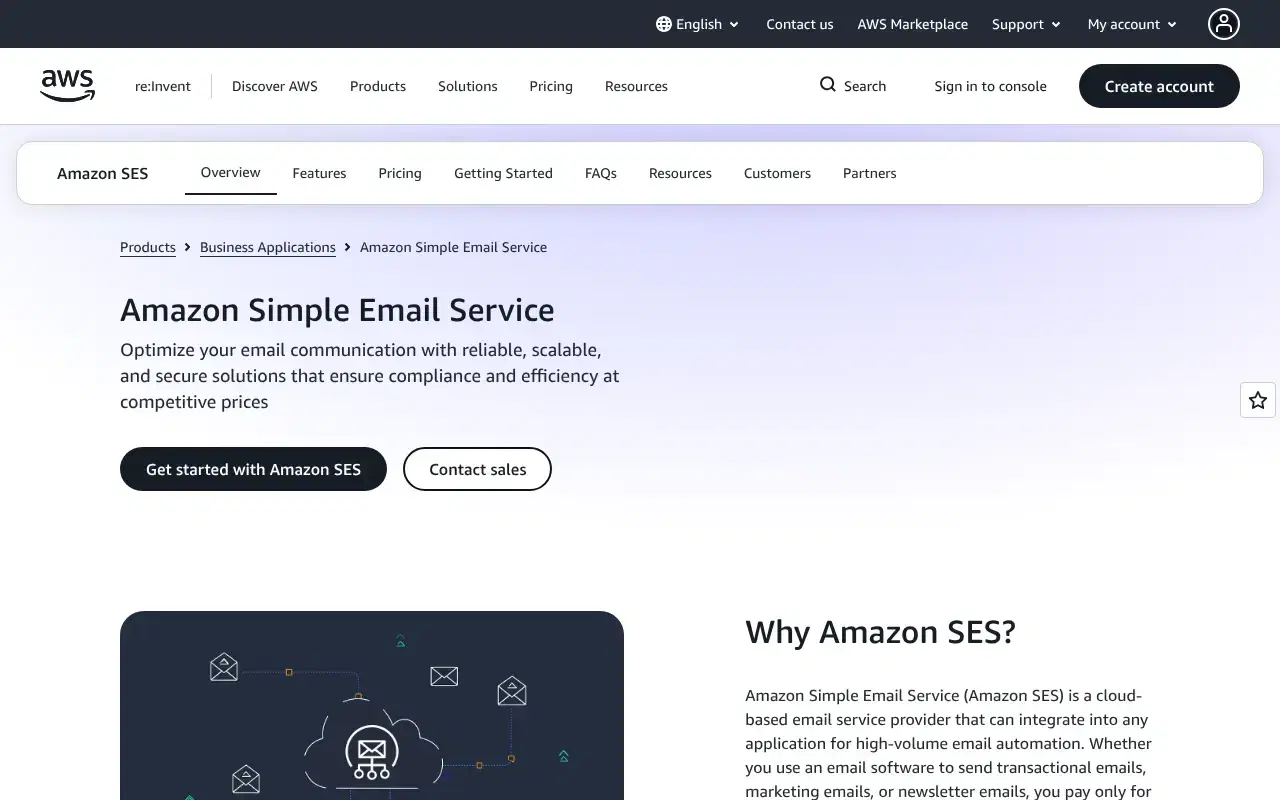
#7 · 2.5 / 5
Amazon SES
Best for lowest cost at very high volumeAmazon's sending service, inside AWS: the lowest price per email here. You build the rest yourself, from bounce handling to templates and dashboards.
Pros
- $0.10 per 1,000 emails on pay-as-you-go pricing
- Runs inside your AWS account and IAM
- Inbound email as well as sending
Cons
- No campaign builder or audience tools
- Bounce handling, dashboards and reputation work are yours
- Free plan
- None for SES; new AWS accounts get up to $200 in credits
- Paid from
- $0.10 per 1,000 emails (new accounts start on a $0.16 plan)
- Priced by
- Emails sent
Scores side by side
| Product | Free plan20% | Developer experience20% | Transactional + marketing20% | Switching15% | Deliverability15% | Scale10% | Total |
|---|---|---|---|---|---|---|---|
| Unitpost | 5 | 5 | 5 | 4 | 3 | 2 | 4.3 |
| Brevo | 5 | 3 | 5 | 2 | 3 | 3 | 3.7 |
| Resend | 4 | 5 | 3 | 3 | 3 | 3 | 3.6 |
| Mailgun | 3 | 3 | 2 | 3 | 4 | 5 | 3.2 |
| Postmark | 2 | 4 | 2 | 3 | 5 | 3 | 3.1 |
| MailerSend | 2 | 4 | 2 | 2 | 3 | 3 | 2.7 |
| Amazon SES | 2 | 3 | 1 | 2 | 3 | 5 | 2.5 |
How we scored
This list is for teams sending app email through SendGrid who are weighing a switch. What matters to them: a free or cheap way to keep sending, a modern API, marketing email in the same place, and a move that keeps suppressions.
- Free plan (20%). A permanent free plan large enough to run a small app on, with no card.
- Developer experience (20%). A clear REST API, current SDKs, readable errors and docs.
- Transactional + marketing (20%). Both kinds of email in one product, on one contact list and one bill.
- Switching (15%). An importer, or a documented path, that moves SendGrid contacts, suppressions and templates.
- Deliverability (15%). A long public record of inbox placement, and the tooling to protect it.
- Scale (10%). Proven at very high volume, with dedicated IPs and enterprise plans.
Each product gets 1 to 5 per criterion, from its own pricing and docs pages. The total is the weighted mean, so changing a weight re-ranks the list.
Why Unitpost scored 4.3
- Free plan: 5/5. 5,000 emails a month free for good, 200 a day, no card.
- Developer experience: 5/5. Bearer-token REST API, nine SDKs, a CLI and an MCP server, with idempotency keys on sends.
- Transactional + marketing: 5/5. Campaigns, segments and topics share the contact list and the bill with API sends.
- Switching: 4/5. The Migration Assistant imports contacts, suppressions (bounces and complaints) from SendGrid with one key; the guide covers the rest.
- Deliverability: 3/5. Guided SPF, DKIM and DMARC with continuous checks, but a short public record so far.
- Scale: 2/5. No sub-accounts, and dedicated IPs are not launched yet.
Checked November 2, 2026 against unitpost.com/pricing, unitpost.com/sms, registry.npmjs.org/unitpost.
Why Brevo scored 3.7
- Free plan: 5/5. 300 emails a day, about 9,000 a month, on a permanent free plan.
- Developer experience: 3/5. A full API and SMTP relay, shaped by the marketing suite rather than built for developers first.
- Transactional + marketing: 5/5. Campaigns, automation and transactional sending in one account.
- Switching: 2/5. No importer or guide for SendGrid found; contacts move by CSV and the rest by API.
- Deliverability: 3/5. An established sender, without Postmark's public time-to-inbox record.
- Scale: 3/5. Professional plans from 150,000 emails; the focus is marketing teams more than high-volume APIs.
Checked November 2, 2026 against brevo.com/pricing/, developers.brevo.com/docs/mcp-protocol, help.brevo.com/hc/en-us/articles/7959631848850, help.brevo.com/hc/en-us/articles/360021533839, registry.npmjs.org/@getbrevo/brevo.
Why Resend scored 3.6
- Free plan: 4/5. 3,000 emails a month free, capped at 100 a day.
- Developer experience: 5/5. The API many newer providers copy, with SDKs across most languages.
- Transactional + marketing: 3/5. Broadcasts exist, but marketing contacts sit on a second plan and bill.
- Switching: 3/5. A published guide for moving from SendGrid; no importer, so data moves by CSV and API.
- Deliverability: 3/5. A shorter public record than SendGrid or Postmark.
- Scale: 3/5. Higher-volume plans above Pro; less proven at the very largest volumes.
Checked November 2, 2026 against resend.com/pricing, resend.com/migrate, resend.com/docs/dashboard/receiving/introduction, github.com/resend/mcp-send-email, resend.com/docs/send-with-smtp, resend.com/docs/api-reference/api-keys/create-api-key, registry.npmjs.org/resend, resend.com/docs/dashboard/webhooks/retries-and-replays.
Why Mailgun scored 3.2
- Free plan: 3/5. A free plan of 100 emails a day on one domain, with one day of logs.
- Developer experience: 3/5. A capable API on HTTP Basic auth, with a surface shaped by long history.
- Transactional + marketing: 2/5. Built for transactional sending; marketing campaigns need another product.
- Switching: 3/5. A published guide for moving from SendGrid; no importer, so data moves by CSV and API.
- Deliverability: 4/5. Validation, inbox placement tests and dedicated IPs.
- Scale: 5/5. Built for very high volume, with dedicated IP pools and enterprise plans.
Checked November 2, 2026 against mailgun.com/pricing/, mailgun.com/resources/guides/migrating-from-sendgrid-to-mailgun-email-api/, documentation.mailgun.com/docs/mailgun/mcp, documentation.mailgun.com/docs/mailgun/user-manual/sending-messages/send-smtp, registry.npmjs.org/mailgun.js, documentation.mailgun.com/docs/mailgun/user-manual/receive-forward-store/receive-http.
Why Postmark scored 3.1
- Free plan: 2/5. 100 emails a month free, enough to test, not to run an app.
- Developer experience: 4/5. A mature, well-documented API with official libraries.
- Transactional + marketing: 2/5. Broadcast streams send bulk mail, but there are no audience or campaign tools.
- Switching: 3/5. A published guide for moving from SendGrid; no importer, so data moves by CSV and API.
- Deliverability: 5/5. A long public record of time-to-inbox, protected by separate streams.
- Scale: 3/5. Handles large volume; dedicated IPs from 300,000 emails a month on Pro and above.
Checked November 2, 2026 against postmarkapp.com/pricing, postmarkapp.com/migration-guides, postmarkapp.com/lp/mcp, postmarkapp.com/developer/user-guide/send-email-with-smtp, registry.npmjs.org/postmark, postmarkapp.com/developer/webhooks/inbound-webhook.
Why MailerSend scored 2.7
- Free plan: 2/5. 500 emails a month on one domain.
- Developer experience: 4/5. A modern REST API, SMTP and an official MCP server.
- Transactional + marketing: 2/5. Built for transactional email; bulk sending comes on paid plans, without audience tools.
- Switching: 2/5. No importer or guide for SendGrid found; contacts move by CSV and the rest by API.
- Deliverability: 3/5. An established sender, without a long public inbox-placement record.
- Scale: 3/5. Plans for growing volume; fewer enterprise tools than the incumbents.
Checked November 2, 2026 against mailersend.com/pricing, developers.mailersend.com/mcp, mailersend.com/help/smtp-relay, mailersend.com/features/inbound-emails, developers.mailersend.com/api/v1/webhooks.html, registry.npmjs.org/mailersend, developers.mailersend.com/api/v1/inbound.
Why Amazon SES scored 2.5
- Free plan: 2/5. No SES free tier; new AWS accounts get up to $200 in credits.
- Developer experience: 3/5. AWS SDKs and IAM: powerful, with more setup than an email API.
- Transactional + marketing: 1/5. A sending service; it has no campaign builder.
- Switching: 2/5. No importer or guide for SendGrid found; contacts move by CSV and the rest by API.
- Deliverability: 3/5. Good infrastructure, but reputation monitoring is your job.
- Scale: 5/5. AWS-scale throughput and dedicated IPs.
Checked November 2, 2026 against aws.amazon.com/ses/pricing/, docs.aws.amazon.com/ses/latest/dg/smtp-connect.html, docs.aws.amazon.com/ses/latest/dg/smtp-credentials.html, docs.aws.amazon.com/ses/latest/dg/vdm-dashboard.html, registry.npmjs.org/@aws-sdk/client-sesv2, docs.aws.amazon.com/ses/latest/dg/receiving-email-notifications-contents.html.
Frequently asked questions
Does SendGrid still have a free plan?
Which SendGrid alternative is cheapest?
How do I move off SendGrid?
Go deeper: Unitpost vs SendGrid · Migrate from SendGrid · SendGrid vs Mailgun · Move off SendGrid SMTP
Start free
Start sending email your users actually receive
5,000 emails a month free — full API, SMTP relay, templates, tracking, and webhooks. Create a key, verify a domain, and send in minutes. No credit card.